
Home / Choosing
Choosing well before a CNFans order: sellers, items, catalogs and agents
Several choices come before every order, and each has its own deciding page. This page takes them one at a time, with the checks that actually tell you something.
How to judge a seller from the listing itself
Final say here: the seller's listing
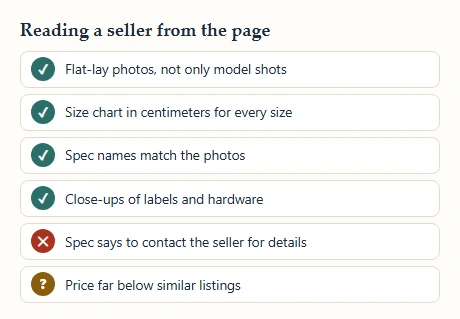
You will rarely know anything about a Chinese seller beyond the listing, so read the listing as evidence. Good sellers tend to show the item laid flat on a plain surface as well as on a model, keep the same background across their photos, give a size chart with centimeter figures for every size, and name their specs in a way that matches the photos.
Detail photos of labels, stitching and hardware are a good sign; so is a note that is specific about pre-orders or restock dates. Warning signs are the opposite: only styled model shots, a size chart that covers one size, spec names that say to contact the seller, or a price far below similar listings for no visible reason.
How to choose an item you will keep
Final say here: the seller's listing
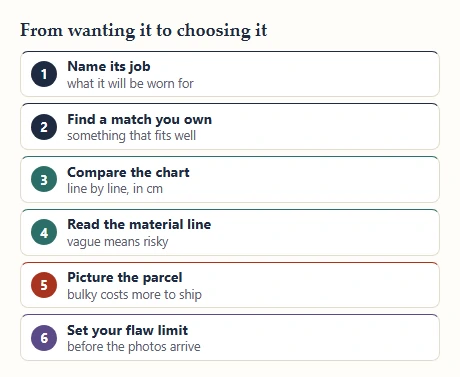
Most disappointment comes from fit and fabric, not from defects. Before choosing an item, decide what it is for and find something you already own that does the same job well. Measure it flat and compare with the size chart, line by line. Read the material line on the listing; a vague one is a reason to look elsewhere when fabric matters.
Think about shipping too. A bulky coat or boxed shoes can cost more to send than a heavier pile of T-shirts. And decide in advance which small flaws you would accept, a loose thread or a slightly off print, so the warehouse photos lead to a quick decision rather than a long one.
Five slips to catch at the payment step
Final say here: the catalog card
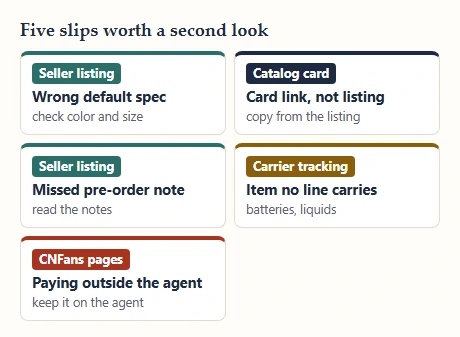
A handful of mistakes made before you pay account for most avoidable trouble. Watch for a spec chosen by accident (the default color is not always the one in the photo), a link copied from a catalog card instead of the listing, and a pre-order note you skimmed. Check that a line to your country will carry the item, especially anything with a battery or liquid, and that your customs office allows it.
Never pay a seller directly because a message asks you to, and never move a conversation off the agent's own system to save a fee. Keep the listing screenshot from the moment you paid; if the seller edits the page later, it is your record.
Testing a spreadsheet site before relying on it
Final say here: the catalog card
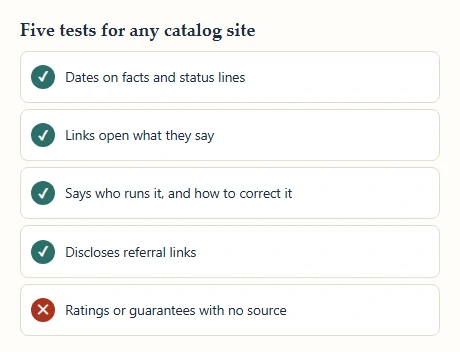
When choosing a spreadsheet site, meaning a catalog of products to buy through an agent, look for one that shows its working. Pages carry dates. Links open the listing they claim to. It says who runs it and how to report an error, and it discloses that links may earn it money. It does not pretend to be the agent, invent ratings or promise outcomes it cannot control.
Evaluate this guide by its dated service checks, clear separation from CNFans, and disclosed referral tags. The about page describes its method. A destination’s current price or availability must still be checked on the live listing.
Vetting an agent from its own written pages
Final say here: CNFans pages
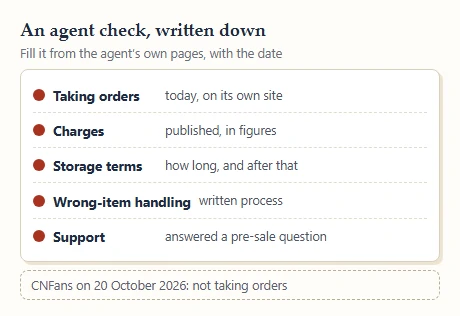
Choosing an agent is less about reputation than about what it writes down. A trustworthy agent publishes its charges, its storage terms and what happens when a seller sends the wrong item, and it can be reached through a support channel that answers a pre-sale question. It also needs to be open: a site that cannot take orders cannot be your agent this week, however good its record.
Measured that way, CNFans is a pause for now. Its archived pages did not name the company behind it or print fee figures we could read, and its site shows a maintenance notice as of 20 October 2026. When it returns, run the same checks on its own pages before ordering.
Words on a catalog card that need checking
Final say here: the seller's listing
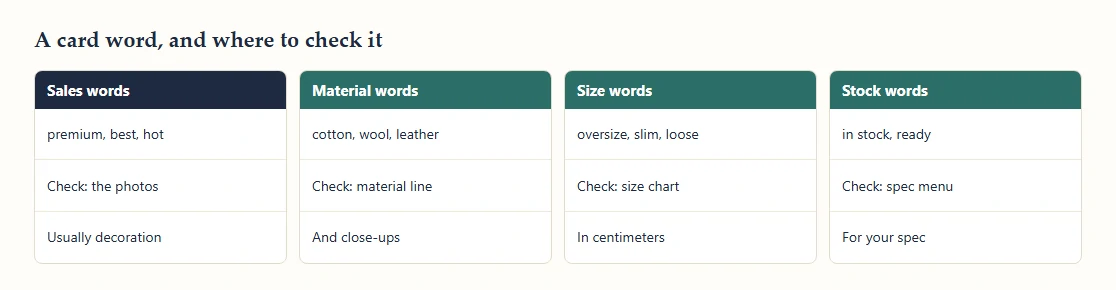
Card titles are usually built from the seller's own wording, often machine-translated, so they pick up sales words that mean little. Premium, hot, best and limited describe the seller's hopes, not the item. Color names drift in translation, and size words such as oversize mean whatever that seller's chart says.
Treat every adjective on a card as a question for the listing. Material claims are checked on the material line and the close-up photos, stock claims on the spec menu, and size claims on the chart. If the listing cannot back a word up, ignore the word.
Turning a shortlist into one order
Final say here: the catalog card
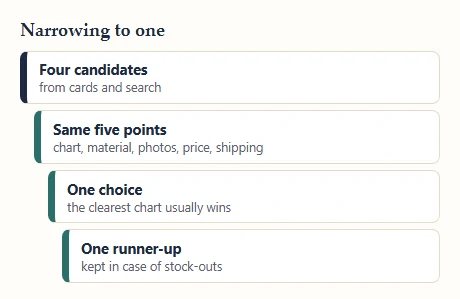
When three or four listings look similar, line them up on the same points: size chart for your size, material line, photo quality, price for your exact spec and the seller's shipping charge. One of them usually pulls ahead on the chart alone, because sellers that measure every size carefully tend to be careful elsewhere too.
Keep the runner-up. If your first choice is out of stock when the agent tries to buy, you can switch without starting over, and the decision you already made still holds.