Home / QC photos
QC photos for CNFans orders, and how to read them
Warehouse photos are the first neutral look at your item. This page covers what they are, how to check them in a set order, and what no photo can tell you.
What QC photos are, and who takes them
Final say here: warehouse photos
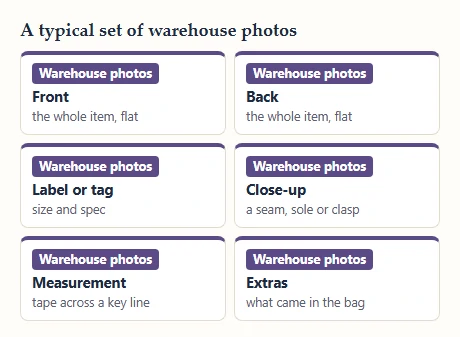
QC stands for quality check. Once an item lands at the warehouse, workers there open the box and photograph the contents on a plain surface, usually from the front and back with a few close shots. Some agents add a tape measure across key points; many offer extra photos or checks on request.
The CNFans homepage dated 23 August 2026 described an arrival check. The photo set below is a practical inspection checklist, not a guarantee that every view or measurement is included. Check the account’s current service scope and any additional-photo charge.
A QC checklist in the order that saves time
Final say here: warehouse photos
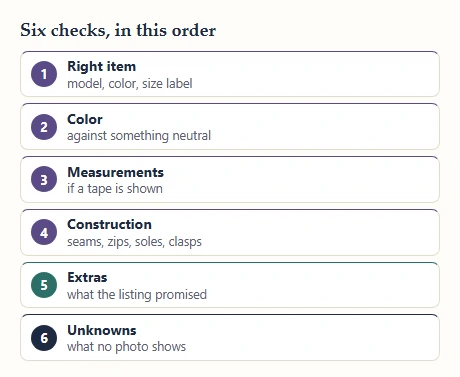
Read the photos in a fixed order and you will catch the big problems before you spend time on the small ones. First, is it the right item: the right model, color and size label? Second, color, judged against something neutral in the frame. Third, measurements, if a tape appears.
Fourth, construction: seams, zips, soles, clasps and prints, the parts that fail first. Fifth, extras: dust bags, spare laces, straps, whatever the listing said was in the box. Last, write down what the photos cannot show you, so you decide knowingly rather than by accident. Doing it in this order means a wrong item is caught in the first minute.
Reading a measurement photo
Final say here: warehouse photos
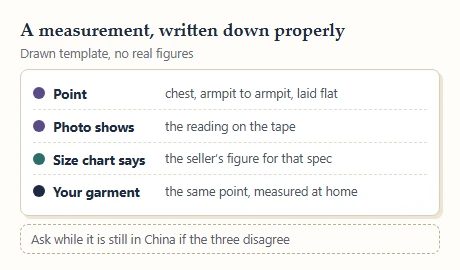
A measurement photo is only useful if you know what was measured. Look at where the tape starts and ends: chest width is measured armpit to armpit on a flat garment, length from the highest point of the shoulder to the hem, and so on. Then compare that number with the seller's size chart and with the same measurement on a garment you own.
Small differences are normal; many size charts carry a note that hand measurement can vary a little. Large ones, or a tape laid across a bunched or stretched garment, are worth asking about while the item is still in China.
Color, judged against something neutral in the frame
Final say here: warehouse photos
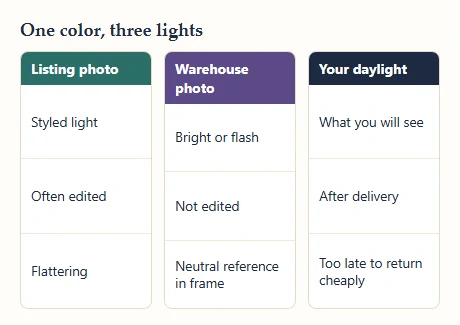
Warehouse photos are usually taken quickly under bright indoor light or flash, which can push colors cooler, flatter or brighter than daylight. Screens add their own shift. So judge color against something in the same frame whose color you know: a white label, the paper of a tag, a ruler, the background.
If the item looks off against those, the item is probably off. If everything in the frame looks shifted the same way, it is the light. When it matters, such as matching a color you already own, ask whether a daylight photo is possible before you approve.
Where to look on a garment
Final say here: warehouse photos
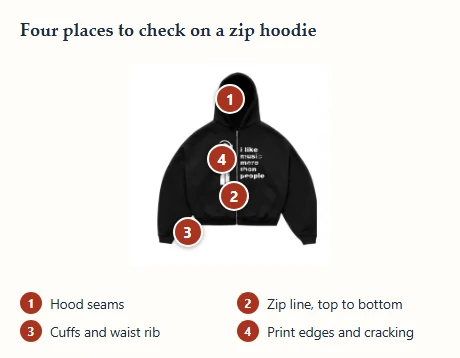
Most problems show up in the same few places. On tops, look at the hood seams, the zip or button line, cuffs, hem and any print or patch, where cracks, loose threads and crooked placement are easy to spot. On trousers, the waistband, pockets and hems. On shoes, the join between upper and sole. On bags, the strap anchors and corners.
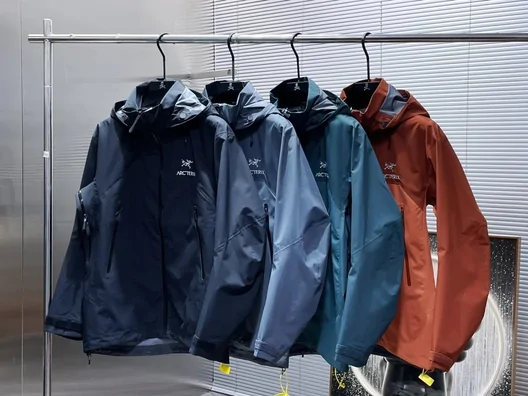
The photo beside this text is a catalog cover shot, not a warehouse photo, used only because it shows a garment clearly. Warehouse photos are plainer; the places to look are the same.
What no photo can tell you
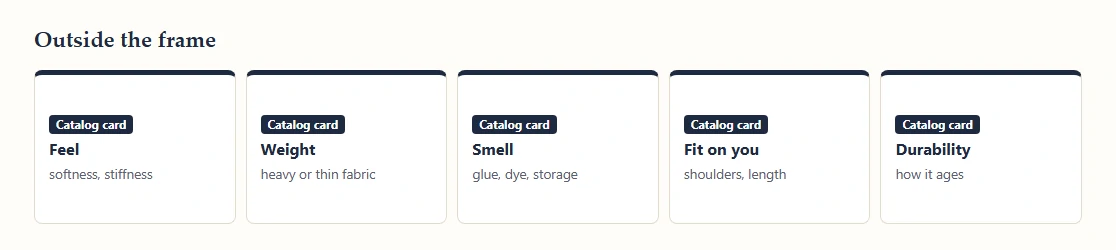
Photos carry shape and color and nothing else. They cannot tell you how a fabric feels or how heavy it is, whether something smells of glue or dye, how a zip sounds and runs, or how a garment sits on your shoulders. They also say nothing about how an item will last.
You can narrow the gap: ask for a measurement you care about, or for a video if the agent offers one. But some risk stays with every remote purchase, and deciding in advance how much of it you accept is part of ordering well.
Acting on a problem before it ships
Final say here: the seller's listing
For a wrong item or a visible defect, contact the agent before international dispatch. Send the selected option and the relevant photos together, then ask about the available remedy, return deadline, shipping and service charges, and refund destination. A domestic return may be more practical, but the item’s location alone does not guarantee acceptance or a balance refund.
Send the agent the warehouse photos that show the problem, your spec note and the listing screenshot. Expect a domestic shipping charge for the return and some days of waiting. CNFans's own return process was not on the pages we could read, so follow what its order page says when the site is back.
Use the seller photo as a reference, then ask for evidence
Four jackets hang on the rail below: dark blue, lighter blue, teal and rust. They share a hooded shape, but this image alone does not identify the selected size or show the inside of any seam. It is a seller reference photo, not a warehouse inspection.
- Keep the option evidence. Save the colour label from the menu and the corresponding picture.
- Check the arrival evidence. Request a clear front view and size label for the actual item, with additional angles where needed.
- Describe the difference precisely. “Ordered rust; arrival label says navy” is more actionable than “wrong jacket”. If the label matches but the light looks different, ask for a neutral reference in the frame.
A photograph may show an open seam or a missing fastening. It cannot certify material composition, waterproof performance or authenticity. Treat those as separate claims that need suitable evidence, rather than inferring them from a tidy photo.