Home / Shipping
How a CNFans parcel gets weighed, priced and carried
From the warehouse shelf to your door. The agent quotes, the carrier carries and customs decides; this page sorts out which of them settles what, and what you can still change.
Actual weight against size-based weight
Final say here: CNFans pages
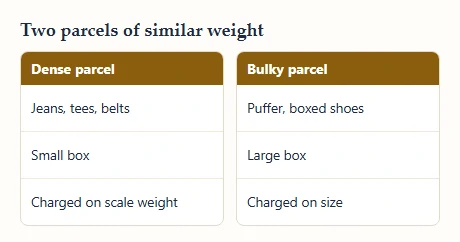
Lines charge for space as well as weight. A parcel's size-based weight is worked out from its length, width and height using a divisor the line sets, and the line charges on whichever is higher, that or the weight on the scale. Dense things such as jeans tend to be charged on scale weight. Light, bulky things such as puffer jackets, boxed shoes and stiff bags tend to be charged on size.
The quote CNFans shows decides which rule applied. If a quote seems high for a light parcel, size is the likely reason, and packing is where you can change it.
Combining items into one parcel
Final say here: CNFans pages
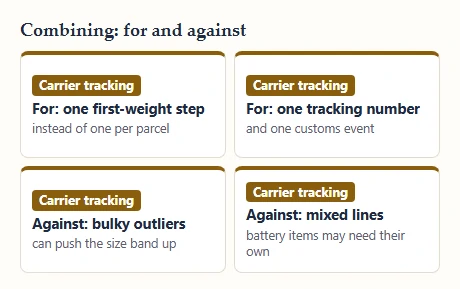
Consolidation means packing items from several sellers into one parcel. It usually saves money, because most lines charge a first-weight step and then less for each extra step, so one parcel of four items beats four parcels of one. You also get one tracking number and one customs event instead of several.
It is not always right. A single very bulky item can push a combined parcel into a costly size band. An item with a battery may need a line the rest do not, and one damaged parcel means everything is delayed together. Ask for quotes both ways when a parcel mixes very different things.
Packing choices that change the quote
Final say here: CNFans pages
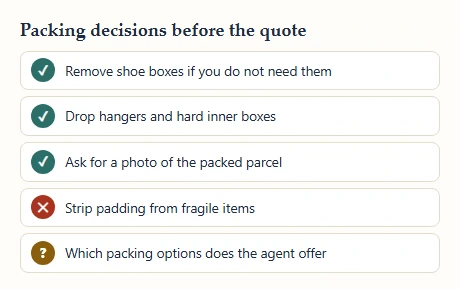
Packing is the one shipping cost you can influence directly. Shoe boxes, hard gift boxes, hangers and bulky inner packaging add size without adding value; agents commonly offer to remove them. Soft items can be folded tighter. Fragile items go the other way and need padding, which costs space.
Ask CNFans what packing options it offers once its site is back, rather than assuming any particular one, and ask for a photo of the packed parcel before paying the line. That photo is the record of what left the warehouse and how it was protected.
Choosing between lines
Final say here: CNFans pages
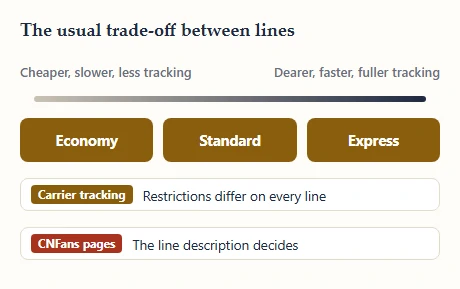
Each shipping line is a route plus a set of rules: which countries it reaches, what it will carry, how it charges, and how well it can be tracked. Economy lines are cheaper and slower and often track less. Express lines cost more, move faster and usually hand over to a well-known local carrier with full tracking.
Read the line description before you pick on price. A cheap line that refuses batteries is no use for a parcel with headphones in it, and a line without door-to-door tracking makes a missing parcel much harder to chase. The line description CNFans shows when you choose is the deciding page; screenshot it.
Items lines refuse or restrict
Final say here: the carrier's tracking
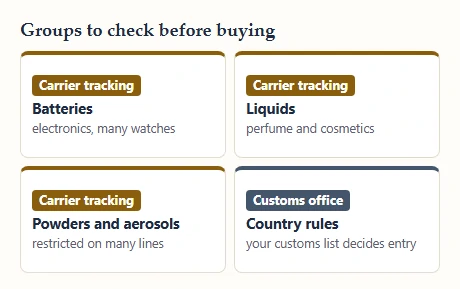
Some product types in the catalog are harder to ship than others. Electronics and many watches contain batteries. Perfume is a liquid and often flammable. Powders, aerosols, magnets and anything sharp are restricted on many lines. Agents generally refuse to send what no line to your country will accept.
Two pages decide here, and both matter. The line description says what the carrier will take. Your customs office's list of prohibited and restricted goods says what your country will let in. Check both before buying anything in these groups, not after it reaches the warehouse.
Tracking, from the agent's number to the local carrier
Final say here: the carrier's tracking
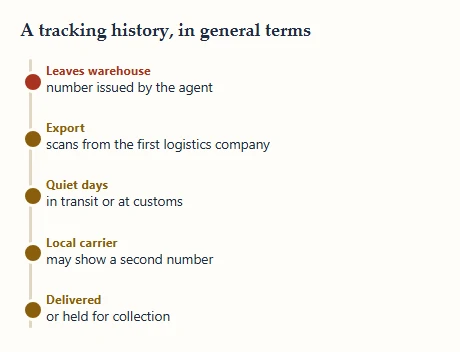
When the parcel leaves, CNFans gives you a tracking number. On many lines the first scans come from a logistics company in China and the later ones from the carrier that delivers in your country, sometimes under a second number. Stretches of several days with no new scan can happen while a parcel is in the air or waiting for customs.
The delivering carrier's own tracking page is the deciding record for delivery attempts and where the parcel is held. Use that page rather than a summary inside another app, and screenshot it on delivery day or on the day anything goes wrong.
Customs and the delivery step
Final say here: your customs office
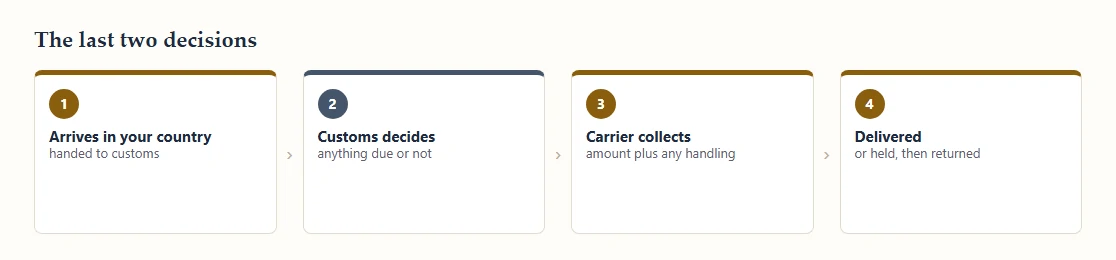
Customs looks at the parcel when it enters your country and decides whether anything is due. If it is, the delivering carrier usually contacts you with the amount and a way to pay, and delivers once it is paid. If a charge goes unpaid, the carrier may hold the parcel for a while and then send it back; how long it waits depends on the carrier and the country.
If delivery fails, the carrier's page says where the parcel is held and until when. Everything at this stage belongs to customs and the carrier, not to CNFans, though the agent can sometimes help chase a parcel through the logistics company it handed it to.